portfolio Case Study: prismatic heart training
Instructional Design · Research Synthesis · Inclusive Communication · Curriculum Development · Visual Storytelling · Video Production
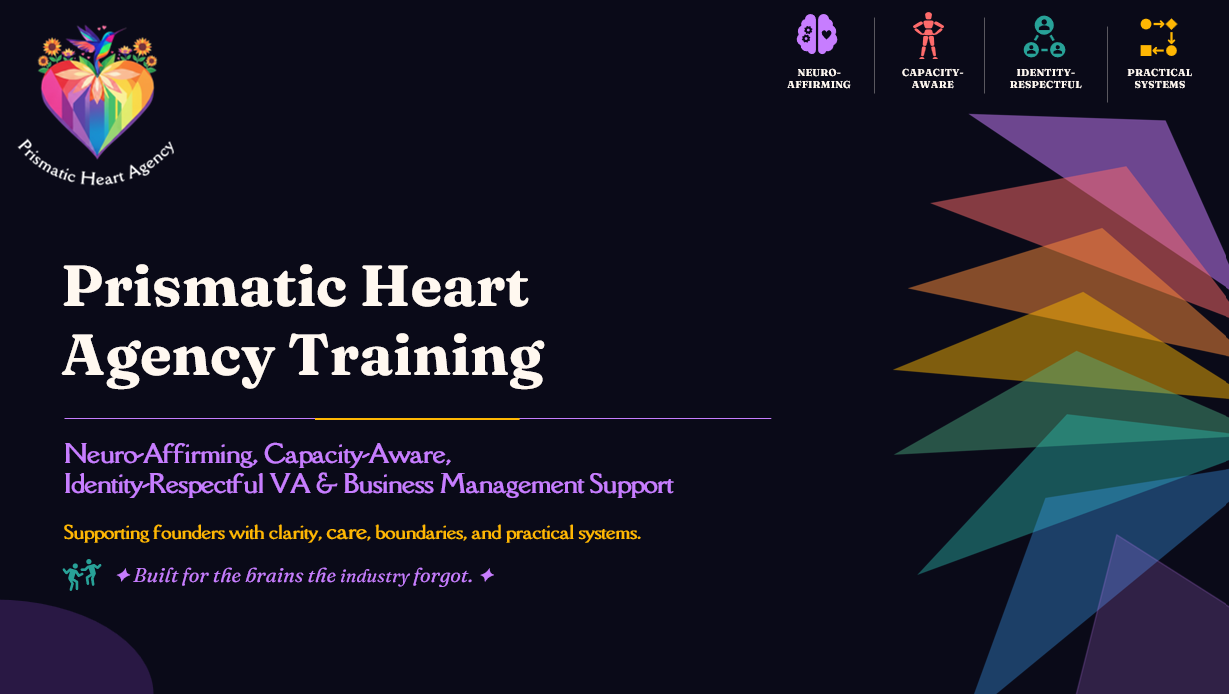
Prismatic Heart Agency Inclusive Training Program
Summary
Prismatic Heart Agency needed a practical training program that would help virtual assistants and online business managers provide stronger support to POC, chronically ill, neurodivergent, and queer founders.
The subject demanded nuance, care, and specificity. The training needed to acknowledge complex lived experiences without becoming clinical, abstract, overly cautious, or impossible to apply in everyday client work.
I developed an interconnected training ecosystem spanning curriculum, visual presentation, narration, scenarios, templates, assessments, and onboarding resources.
THE opportunity
Inclusive support is often discussed through broad values: communicate clearly, be flexible, avoid assumptions, and meet people where they are.
Those values matter—but they do not always tell someone what to do when a deadline slips, a client becomes overwhelmed, written instructions are difficult to process, urgency is unclear, or a well-intentioned workflow creates an unexpected barrier.
The opportunity was to translate inclusive principles into observable situations, concrete responses, and practical tools that assistants could use in real client relationships.
MY ROLE
I led the project’s instructional and content development, including:
Curriculum architecture
Research synthesis
Module development
Scenario writing
Template creation and revision
Slide design and visual storytelling
Narration scripting
Assessment development
Training video planning
Client review and iterative refinement
My role required balancing educational clarity, emotional intelligence, brand voice, visual coherence, and the practical realities of a training experience limited to approximately two hours.
curriculum strategy
I organized the material into 13 modules that moved from foundational understanding into applied support practices.
Rather than presenting identity groups as fixed categories or asking assistants to diagnose clients, the curriculum focused on:
Observable needs and situations
Flexible communication
Consent and preference-setting
Accessible workflows
Repair after mistakes
Sustainable expectations
Minimum viable progress
Support that preserves client agency
The program’s voice remained warm, direct, practical, grounded, and refreshingly honest.
designing for application
The training was built to help learners recognize situations and respond thoughtfully—not merely remember terminology.
A 35-entry Scenario Glossary translated common support challenges into concrete examples, including communication differences, executive-function barriers, reading difficulties, eye-contact requests, vocal tics, chronic-illness variability, and moments of high or hidden cognitive load.
Each scenario centered what an assistant might actually observe and what supportive action could look like, avoiding assumptions or diagnostic language.
WHAT I BUILT
The completed training ecosystem included:
A 13-module Training Program Guide
A fully designed and editable slide deck
Narration scripts for a training experience of two hours or less
A 35-entry Scenario Glossary
An updated template library
A learner assessment and quiz
Revised onboarding language
Practical communication and workflow tools
Training video structure and production planning
The materials were designed to reinforce one another so that learners could move from understanding the concepts to applying them in real work.
Visual and Learning Experience
I translated Prismatic Heart’s brand into a cohesive educational system using its established typography, dark visual foundation, vivid accent palette, and direct but compassionate voice.
The deck needed to remain visually engaging without overwhelming learners or competing with emotionally and cognitively dense material. Layouts, pacing, examples, and narration were designed together rather than treated as separate deliverables.
Collaboration and Iteration
The program developed through close review with Prismatic Heart founder Salome Savage.
Feedback led to refinements in tone, PDA-friendly phrasing, visual clarity, repair language, translation support for VAs, and the framing of Minimum Viable Progress.
Each revision strengthened the connection between the program’s values and the real situations learners would encounter.
Outcome and Value
The final result was not a single training deck. It was a complete instructional ecosystem designed to help assistants support clients with greater clarity, flexibility, and care.
The program gave Prismatic Heart a cohesive foundation for delivering its methodology through training, video, templates, scenarios, and applied learning tools—while preserving the warmth, directness, and human understanding at the center of its work.